Showing posts with label animals. Show all posts

Tuesday, November 30, 2010

lagi bibi

little baby goats
wake me up at five am
with wild jungle cries

Friday, November 26, 2010

bibi bebee

little baby goats
jumping around Oecusse
pooping everywhere

Thursday, September 23, 2010

This biscuit was an animal swam in a brook

That's right, the third ingredient on this biscuit is ground catfish. It's an innovation by the institute of agriculture at Bogor (one of the top universities in Indonesia, I hear) to help kids get the nutrition (protein, most prominently) that their diet lacks. Or at least, so I surmise from the biscuit. The smiley face makes it irresistable to would-be eaters.


Ewa offered me a couple and made me guess what was in them, and I couldn't-- the best I could come up with was coconut, which might not even be in it. They were actually really good by any standards, I ate the second even after I found out what was in the first. They really got it right with this biscuit: not too sweet, but not fishy in the slightest.

It turns out catfish are really easy to farm, and when in biscuit form, are part of a complete breakfast: the biscuit are one fifth protein and one fifth fat.

Tuesday, September 21, 2010

mari kita makan

I could go on forever about how awesome masakan padang is. Although google translates it to "culinary field", the actual meaning is closer to "farmer's food". Masakan padang is rice served with the eater's choices from a spread of vegetables, eggs, soy, fish, meat and other accompanying foods.

One of my favourite things about masakan padang is how all the foods are arranged in plates carefully balanced on an elaborate arrangement of other plates, so that all the food is visible in the front window, even at a distance. It also makes it really easy to serve, by reducing the reaching distance.


Padang is really cheap and also allows vegans and vegetarians (this post is tagged "animals") to eat to their satisfaction and choose from great variety, eliminating the hassle of modifying menus or limiting their choices. In fact, it's got infinite customisability. It's also really tasty, easy and unassuming. A comfort food of sorts. I eat it every day.

Padang of the week:
Price: Rp 10,000 (about $1.12), where I ate it (price can vary slightly)


This one's got rice, vegetables, tempe, a deep fried egg, and chile*. A good place is more than happy to (as pictured) give you extra veg, and drown everything in coconut curry with no extra charge.

The tempe in Bali is consistently amazing. It's firm to the tooth like well done pasta, and yet has a certain creamy texture. It's got that wonderful nutty savouriness to it without the mal-fermented funk that sometimes comes with tempe in the US. And, it's super cheap. The tempe pictured cost about 20 cents. Next time, I'm getting two.

Deep fried egg! is a delicacy all across Southeast Asia. It's got all the nutrition of an egg, with all the delight of a french fry, this one topped with hot chiles and onions.


*There's more! Bali has red and green chile, just like New Mexico does. What a weird coincidence. The recipes are remarkably similar, the green consisting mostly of ripe fresh chiles and the red consisting mostly of ripe dried chiles. They vary in taste from place to place, just like in New Mexico. Some are mild and savoury, others taste like a molotov cocktail.

And whilst die hard New Mexicans like myself swear by green, in Bali, you just have to get both.

Merry christmas!

Saturday, September 11, 2010

Fried rice paradise

Ubud is amazing and a stunningly beautiful place. Perhaps I say this because I do my best to stay away from the main road where all the bars and restaurants and swanky hotels, where all the sunglassed, sweaty tourists hang, which I guess is still gorgeous, by tourist trap standards.

Still, I'm thinking of the Ubud where the road is narrow, houses, shops and warungs (roadside eats) creep onto the sidewalk (that's barely there at all) and vines, bushes and trees and vegetation of all kinds grows over the buildings, trying to take over the street and block out the sky. Behind the buildings, it's thick jungle, or swaths of rice fields. Everyone here is brown (I need to work on being browner).

The architecture here is amazing. Houses have these awesome pitched roofs that slope on all sides but end in a flat top -- sometimes in tile and sometimes with straw, and sit on a flat concrete or raised earth slab, with very square, compact designs. Multi-storey houses keep their awesome roofs, and are stepped, a little bit like Japanese houses or Chinese temples. Families live in these awesome little compounds where houses sit next to each other on their platforms, with little prayer altar arranged all around them. Any space that isn't a house or an altar is groomed as a garden, with stone slabs to walk on, grass, and flowers and decorative bushes. Chickens, cats and sometimes rabbits run around the garden, children play, and brightly coloured birds sit in cages. The whole compound is walled in, sometimes with intricate patterns on the walls, and ornately carved entryways. It's charming and intensely beautiful I'm really not doing its beauty justice with words.


people live here! real people live here. Isn't it beautiful? I don't think any of the people around these parts are particularly rich, but their family compounds are all just really nice, a lot of carved wood and nice artwork. My theory is that so many people live in the same compound that the combined amount of money they can spend on it is quite substantial, and that they've lived in it for so many generations that they've had plenty of time to put some shine on it.


People are really friendly and smile a lot, people I've had extended conversations with are also extremely nice and really interesting. It's funny how in Cambridge, it was rare for me to meet someone who was local, whilst in Ubud, it's rare for me to meet someone who isn't. People also ride scooters around town with crazy abandon, weaving and overtaking all over the road, riding in the wrong direction on two-way and one-way streets. The food is very goreng (fried), but tasty, well portioned and nicely arranged, and the weather is a few degrees cooler, because Ubud is a little higher up in the hills, than the rest of Bali.

The first evening, I walked to a little hole in the wall warung, the kind of place the local boy at my homestay tells me he would go to eat at, and I walked by a small terraced paddy field tucked away in someone's back yard next to a plot of bananas and a little pen with hundreds of little ducklings in it, coconut trees shading everything. How's that for an urban garden?


Ubud is in grave danger! Already there's a Starbucks on the main road, with word that a McDonalds is on the way. Most of the shops in town are very shiny and polished, may selling upmarket clothes and perfumes and things that you could find anywhere else, really. There's even a fish spa, a nutty Chinese or Japanese idea where the customer puts his or her feet into a tank and fish nibble on them. In pandering to western tastes, Ubud is losing its architecture, its local food and all its charm and culture, fast.

I blame it on the tourists. I think tourism is a great way to bring money into a country and create business, but it's sad what lousy tourists can do to a place.

Wednesday, August 11, 2010

Hippy hoppy

After visiting IDDS, I had a great week-and-a-half in Santa Fe and other places, NM. I stopped on the way back for claw fights atop Mesa Mentosa and camping at Ghost Ranch (one of the most beautiful places I've ever been), and happy fun times camping with the Stupin family in Colorado (on the way to and from IDDS). New Mexico is one of the most beautiful places on earth*.


I danced some tango in Santa Fe, which turned out to be really nice. Santa Fe (and surrounding area) has some great dancers, who are super friendly and sweet. I haven't been dancing so much lately, and I forgot how having awesome dances with just a few people can make my evening.


I drove up to Taos, NM with Laura Stup, Papa Stup, and Carla Tennenbaum (artist extraordinaire from Brazil, who was at the last two IDDSes) to see the Earthship office/visitor center.


Earthships are SUPER AMAZING!

There are a few basic principles of Earthships (Earthships are houses people live in). They (quoting Earthship Biotecture):

-Heat and cool themselves naturally via solar/thermal dynamics
-Collect their own power from the sun and wind
-Harvest their own water from rain and snow melt
-Contain and treat their own sewage on site
-Produce a significant amount of food
-Are constructed using the byproducts of modern society like cans, bottles and tyres

Whilst most of these principles are really quite common-sensical (from just a simple efficiency viewpoint), what is really impressive is how well the Earthship folks design and build an integrated system that efficiently and effectively accomplishes the design goals, and continue to improve and optimise their system as they gain knowledge and experience.

The best part? They claim to be pretty much on par with the cost of conventional construction, per square foot. This is a really powerful thing: people no longer need to make an economic sacrifice to achieve an ideal or principle goal.


(Photo by Carla)


This feels like the future to me: it's low impact, it's beautiful, it makes economic sense (of course, don't get me started on how I think that the true costs of producing goods and electricity and disposing of waste are not presented accurately to the consumer, encouraging people to live unsustainably), and, to use the words of the Earthship folks, if your pocket is deep enough [they] can design and build anything you want.


Still, I'm not one hundred percent satisfied with where Earthships are, just yet. There are two things that I'm just a little unsettled by:

The simpler of the two to explain is that many of their buildings use aluminium cans and glass bottles as "bricks"/filler material for concrete or adobe, to make walls. This is in line with their principles of using recycled materials, and also allows neat designs (in the case of bottles, it lets light pass through walls). I have a problem with them using cans in construction because aluminium is such a high value recyclable material. (glass does not have this feature) It takes a fraction of the energy to smelt new aluminium to melt down old aluminium and re-use it. And it takes a ton of energy to smelt new aluminium.

It just struck me as a little bit careless.

The second thing that unsettled me was a conversation between a visitor and a staff member. It wasn't quite a conflict as a clash of ideals: the visitor had a house that was hooked up to the electrical grid, had an array of solar panels and was able to sell electricity back to the grid (produce a surplus of energy) despite using electric stoves and electric heat. The staff didn't seem to approve of being connected to the grid, as if it might undermine the house's energy independence -- even though the house was actually energy positive, and Earthships rely on propane, a fossil fuel, for cooking and heating.

I didn't have a problem with the ideas put forth per se, but was surprised by the defensiveness and disapproval.


Still, final verdict: Earthships are super awesome! One day I'll live in a house that works just like that, harvests water and solar power and grows crops and has chickens (for eggs) and fish (for fish) which eat micro organisms that feed on the sewage stream of the house. Maybe goats?


*


All photo credits: Laura Stupin

Thursday, February 4, 2010

safi sana

Back in Cambridge, it's all reverse culture shock again.

In Arusha, hot on the heels of 2010 (which we celebrated with a second goat)-

I think this will be a ramble...
Let me take a couple of seconds to recount history. We celebrated Christmas with a goat. Now, I very much believe in living lightly on the world, and as such I choose to consume next-to-no animals and animal derived products (I also cycle everywhere, althought I must say this is as much out of convenience as concern, and showering is another story entirely-) although I am not opposed to the consumption of animals on any kind of moral grounds. I would be super excited keep chickens for their eggs (it's a beautiful, if an essentially weird relationship if you ask me). They would eat worms and crap and kitchen scraps, and eating them would affirm the ancient adage that we are what we eat: at the end of the day, poop.

And the great Tom Waits did say, "most of the things you absorb you will ultimately secrete."

I would hunt animals for food, if I had to. If I was in the jungle and had to eat an animal to survive, I would, easy. So whilst I did not eat this goat, I did watch its slaughter and subsequent parting out into various cuts and edible bits with great interest. After all, in America, goats come in parts from the supermarket. This was a real goat, it had to die and be parted.

It was the most visceral experience of my life thus far, I must admit I felt a little strange watching blood run and hearing air hiss from lungs. I don't think death had ever been this close, apparent, or bloody to me before. Watching the goat be cut up was easier. It reminded me of a time in Boston before I attended a sustainability fair and watched an artisan butcher skilfully cut up a (happy?) organic free range hog.

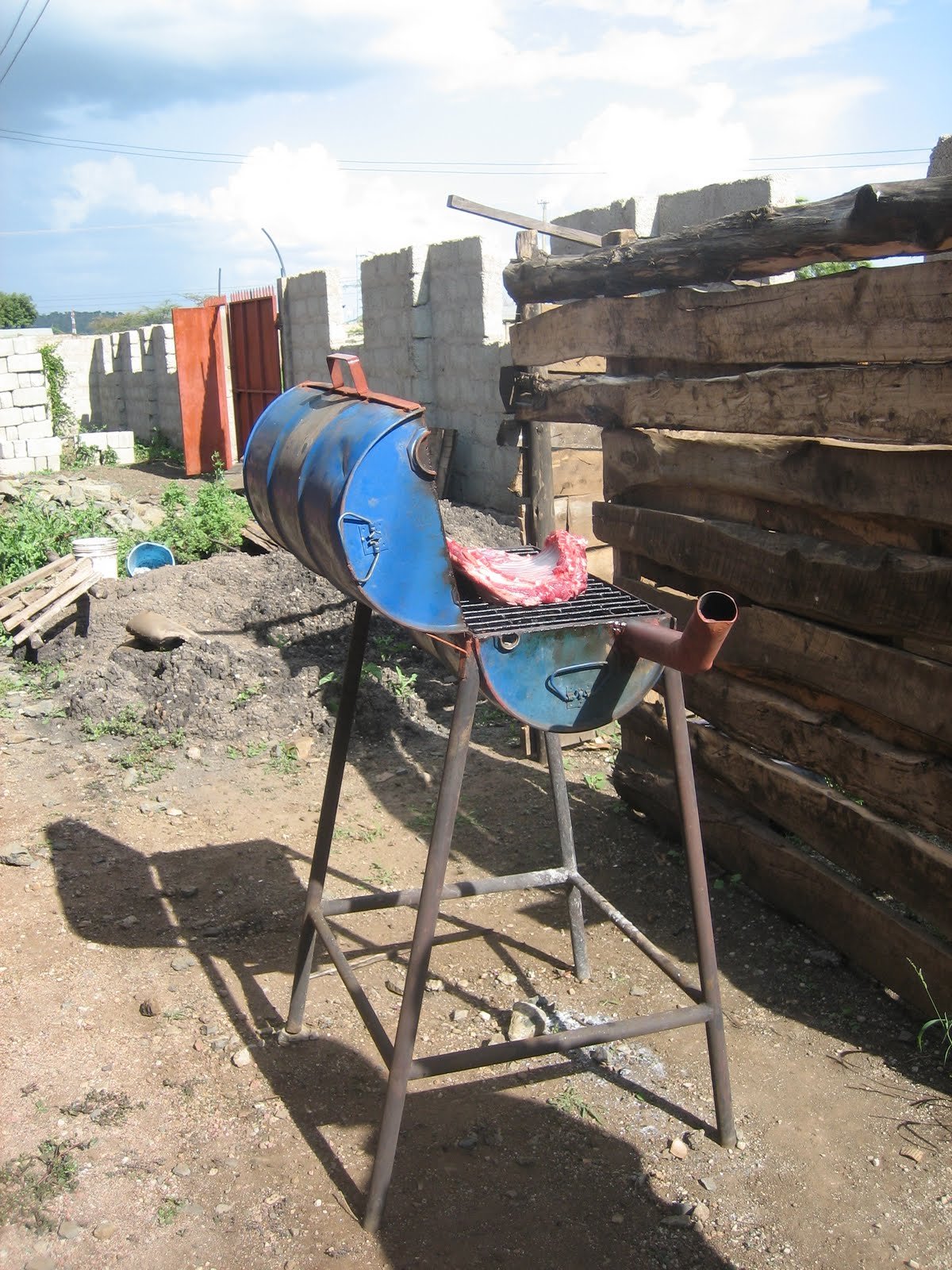
This brings us now to the second goat (this one seemed to come conveniently already in parts -- the skin was nowhere in sight), roasted in a grill made out of an oil drum at Shaibu's swanky bachelor pad, where we celebrated the new year. Shaibu is a dude. He manages the bike programs at Tumaini, the workshop at Global Alliance for Africa's Vijana (youth) centre. Many people have overheard conversations about the centre (mostly in America) and thought we were talking about something else altogether.


"Damn! The meat won't fit on the stove! Good thing we have this nifty oil barrel grill!"


Our stay in Arusha was punctuated by visits to the nearby village of Nadosoito to demonstrate and gather views and feedback about GCS products. The first ended up being mostly a long, scenic walk through the village, which is absolutely beautiful: mountains on the horizon, and filled with beautiful people working hard in fields. The second was accompanied by business and management guru Javier, who taught us so so many lessons about how to characterise a market (besides talking to people and finding out how much land they had and how their harvests were- which we did), how to find demands for a product and willingnesses to pay, and also neat tricks on finding information about customers. The trick is, quite unintuitively, to try lots and lots of different ways to sell your product to different people. And we sold one, and sat in the shade of a mud brick house drinking tea and talking to John the farmer about his harvests, his family. Bernard's father did mechanical work for John, and John knew Bernard since he was but a child. Small world.


----


We passed our following days building up documentation and fiddling with corn shellers (did you know the majority of maize eating people worldwide shell their maze by hand?), learning to build dynamo-cellphone chargers by hand on our daily trips to Mwamba's house.

We had two last adventures before we departed this magnificent city. The first of these was the Mama Afrika circus, with acrobats who jumped and twisted through the air, climbed poles upside down and swung from trapeze and silk (which was announced by the circusmaster as "aerial tissue"). There were young boys who could bend their bodies in half the wrong way, and squeeze through squash rackets. There were also three young men who:

-juggled clubs
-juggled little straw hats (their routine was amazing)
-rapped
-breakdanced

I was also unwittingly recruited by a clown to be part of his four piece rock band. I was lead vocal.

The second adventure was a leisurehike with the D-lab Tanzania team through the lush green foothills of Mount Meru to a waterfall. Rain mid-hike made the going treacherous and slow, and I began to get frustrated with what began as an fresh, exciting hike on a beautiful day. We walked our way down a winding stream in a jungle river valley, hopping over slippery rocks, and ducking under outcroppings of rock worn down by years of water. Finally, we arrived in a huge clearing I can't seem to find a good object to compare in size to. It was completely overgrown with lush green vines and gigantic ferns, a wispy stream of water rushing from some high place to crash down two hundred feet below. It felt like I was in the land of the dinosaurs.

Alas, great things must come to an end, and a few days later, I passed through Nairobi, got on a plane and went "home" to Singapore for a few days. It had been a long time, my parents had moved into a new house, and Singapore was as weird as ever. Nevertheless, it was a pleasant week spent at home.


Life goal: only own so much stuff that I can carry on my back. It's slow progress, but I've stopped checking bags on airplanes, and learning my goal one month at a time.


Friday, August 15, 2008

Catch 23

Every language can be spoken in the vocalisation of another language. This makes a crazy fractal number of variations of possibilities for communication from existing languages.

I like it. It's an intriguing little game where interest and effort are rewarded with some form of non-superficial appreciation and respect.

Personal interaction is another world entirely when there is no common, fluently spoken language-- there are more smiles, and less pressure. I'll also never be forced into conversations or asked questions I don't want to answer.


How to buy fish:
1. Woman brings live fish in a bucket to your door. They look like catfish, I think they're caught from streams and rivers
2. After you pick your fish and pay, woman clubs fish on the head to death with a block of wood
3. Woman guts fish

Saturday, May 24, 2008

Sheepface

In India, there are two cows for every three people.

40% of people registered as below the poverty line have paid a bribe for it.


One rough guide. Two skirts. Three pairs of underwear.

See you in India.


Okay, four pairs.