Showing posts with label india. Show all posts

Wednesday, May 26, 2010

Good jelly

(if you like bikes, building stuff, or design for developing countries, click all the links!)

On this sunny day did five intrepid explorers ride from olde Cambridgeport to Carlisle to visit the honourable Gwyndaf Jones.

Not only is Gwyn one of my favourite people ever, he's also Welsh. Over lunch he recounted a story from a past visit to Wales. Apparently, there are so few Welsh names and so fewer surnames, that when our hero found himself standing in a cemetery, he had to look but two stones away to find the grave of one Gwyndaf Jones.

---

Spang, Daf (another Welshman who makes my list of favourite people ever), Amelia (who rode across the USA last year!), Laura and I put some food, brews and ice into some panniers and rode up the lush green Minuteman trail and then into the woods to find Gwyn at his gorgeous little house.

Gwyn has an amazing story. He worked as a BMW motorcycle mechanic once, and started one of the first super-high-end titanium racing bicycle companies, Merlin Metalworks, just one town over in Somerville MA. Today, he's a mentor for D-lab design classes, and teaches his own cycle-focused class at D-lab. He collaborates with Guatemalan bicycle-machine inventors and builders, and Indian rickshaw businesses, to name a few.


Gwyn's house is beautiful and cosy, and his workshops and store rooms packed with the most exquisite hand tools and bicycle history: old bikes, one-off crazy experimental bike frames, and beautiful (and huge) hand saws, planes, and files. We brave mosquitoes the size of bees on a little jaunt into the woods by his house, where a tree hangs with a hundred rejected Merlin frames, the steel completely rusted but the titanium pristine and shiny.


Alas, all good things do end and Gwyn took us on a lovely ride on a track through the woods on our way back to Cambridge. I'm already planning my next ride out to Carlisle.


Wednesday, March 11, 2009

Days of sunny persuasion

India was a rough time. I'm starting to feel more fulfilled by the it now, long after the experience itself (just as all my wise friends told me I would).

I was so ambitious, and whilst it didn't always (or ever) seem like I was accomplishing or learning anything, I suppose I did. It was just a bit of cultural chafing. In the West, NGOs are purposed, lean, struggling. In India, sometimes they're just family businesses, something to spend your working hours doing, somebody to employ your important uncle's cousin's cousin. I got some good experiences, some decent learnings.

Now, even the long, painful train ride seems nostalgically pleasant in memory.

I still remember wide open endless empty beaches, at least two difference places where the sky was filled with eagles, homegrown appropriate technology foundation, gorgeous cloudswept mountains, complex (but not particularly exciting) costumed music and dance, and of course, Auroville's nigh-utopian Solitude Farm and its rockstar crew of farmers-by-day, Indo-pop-jazz-musicians by night.

Add this to the list of days that could be perfect:

I wake up with the sun here


and take in the view of the farm and its surroundings from the rickety, 30 metre(?) windmill. It's mostly grassy plains and clumps of trees, and I can spot four other windmills, each painted with distinctive colours. I eat a modest breakfast including bread, PB and herbal tea, sitting with some really neat people on a stone floor in a circle. I pick papayas with Lowell, we take turns prodding them off trees with a long stick and catching them as they fall. We sneak a couple of small, ripe ones.
We work in the fields, planting and thinning corn, running water through channels, building compost piles. It's hot, sweaty work. I take a quick shower with my clothes on half way through. Lunch is millet and lentil cakes swimming in curry. They are beyond words amazing, my mouth is watering just thinking about precisely that meal.
Lowell and I walk about the farm and talk in the afternoon. We hang out in his small blacksmith hut. Soon, he has to he has to get ready for The Show. I cook a simple dinner with some of the other people, of red rice, tomato-onion sauce and watery lentils (like they seem to enjoy here) and we head over to a Indo-pop-jazz concert to end all Indo-pop-jazz concerts. The afterparty is at Solitude and there is amazing food, and singing to ukelele and guitar. We croon out such great hits as "Freight Train", "Rivers of Babylon" and "Lovely Rita" late into the night.

The best part of this, is that it's true life.

That summer reminded me a couple of times how amazingly lucky I am in the places I chance upon and people I meet. Weeks later, I met just the most incredible couple on a train up to Thailand from Singapore. They taught at a school in Chiang Mai, and had adopted two Sri Lankan orphans. I won't write it here, but I also got the most amazing how-my-dad-wed-my-mum story out of M. If you ask me to, I'll gladly tell it.


Wednesday, October 22, 2008

Life with the street cows

I forget I'm still a student sometimes. Other times, I absolutely chafe at being one.


Have mere months passed since I lounged in fallow fields chewing leaves and ducked through waking-dream-surreal banana groves at Solitude farm with Lowell, talking about growing up, growing out, wearing skirts and reverse culture shock?

We talked about skiving and slouching through school, dropping out and finding alternatives, learning through non-academic experience, learning crafts for their sake alone. Lowell has a homemade foundry and is an aspiring blacksmith. Blacksmithing is brilliant, and grand. We laughed about how an African in full traditional garb doesn't get a second look on New York City streets but a boy in a skirt, well, does. We talked about bicycles, teenage years, low-cost low-complexity adaptation-friendly technology, music, educational systems. And reverse culture shock.

Today, I grind through school, adding degrees and course loads, trying to best prepare for a career, and life? in world changing. I can't remember the last time I ran off to do something glorious, reckless or life changing because I knew I wanted it. I can't remember the last time I learned something-- a skill or an art-- because I was completely captivated by it.

Yet I know people who did, and they are frickin COOL. Ironically, on the other side of the fence from me, there are people who know so much more about the things I wish I knew, because they decided that they learned better than they were taught, learned things for the sake of those things only, and found places they absolutely wanted to be.

It just happens that I found one at the strange and chance intersection of our lives and travels in a developing country.

All too quickly, it's screeching reverse culture shock, and back to Singapore, back to Boston and school. It's gut wrenching how I wish I could expand myself in ways the education system (but mostly my school) doesn't permit, the things I wish I could do but for lack of time and too many other things to do. But for such good, awesome people around me to show me, help me, and support me without even realising, I'm sure I would have collapsed and imploded ages ago.

I have a nagging feeling that I would not "be legitimate" without a college degree. I wonder how many times harder it might be to world-change without that-- maybe not at all. Could I run away, live where and how I want to, learn with my hands, live with nothing to prove? "Maybe later."


Part of me wants to believe I'm somehow being groomed by this very-expensive-education that I'm still not yet at peace with.


Banana flowers stewing at Solitude farm. They take forever to pluck out of a big red bud that hangs off the plant, and after that, your fingers are all sticky. They taste like mushrooms, sort of?

Friday, August 15, 2008

Catch 23

Every language can be spoken in the vocalisation of another language. This makes a crazy fractal number of variations of possibilities for communication from existing languages.

I like it. It's an intriguing little game where interest and effort are rewarded with some form of non-superficial appreciation and respect.

Personal interaction is another world entirely when there is no common, fluently spoken language-- there are more smiles, and less pressure. I'll also never be forced into conversations or asked questions I don't want to answer.


How to buy fish:
1. Woman brings live fish in a bucket to your door. They look like catfish, I think they're caught from streams and rivers
2. After you pick your fish and pay, woman clubs fish on the head to death with a block of wood
3. Woman guts fish

Monday, July 28, 2008

So, kan ya kumari or ar u ppukottai?

Culture shock. It takes two months in India to learn that:

1. I should always carry small food items on my person to give to beggars. I'd rather not give money, but don't mind so much if they are disabled or are begging with an alms bowl outside a temple. Seeing beggars is still painful, and this really made me think about the directions and implications of even my smallest, quietest actions towards other people.

2. If I want people to stop pestering me to sell me things, the easiest way is to tell them I have no money - works ten times better than telling them to bugger off.


Ramble>>
In India, seemingly every shop on the street sells the same household items and bags and sandals. With shops perpetually full and nobody seeing to buy, I can't help but ask myself how they survive. An army of tea stands sells the same food and drinks ("No natural ingredients - 100% synthetic syrup!"), people at bus stands sell the same silly, tacky toys, Beggars sometimes come in families, and at the same time most construction is half finished, sanitation and hygiene are sorely lacking, the streets strewn with rubbish. Garnish with gaudy, glaring advertising, cell phones, jewelry and movies and music that scream luxury and materialism, and serve piping hot.

On top of that, there's a-whole-nother world of rural and water and agricultural issues I don't completely understand. Pardon me for seeing problems where you might see character, but it feels as if it would take just a bit of redirection and organisation to turn things around.

Of course, there is probably a mountain of inertia behind the current situation.

I think many of India's problems are definitely cultural / social. For example, it seems to me peoples' values and priorities disposes them to litter. Private before public, and convenience over consequence. All this means is that Indians are only as selfish as the rest of humanity. They just don't have trash bins and the public works to service them. A very small part of me pines that it mirrors global pollution, at a personal level.
>>Rant over

At the same time, tucked away in a corner of Auroville, a group of remarkable people sit around the only light on the farm at night, powered by a solar panel, having conversations that wander into the night, interrupted only by their brewing tea and singing a few songs to an excellent accompaniment of ukulele.

There was not really any other choice than to congregate. The (un)availability of electricity brought people together like moths to a candle. Solitude farm has by far the most efficient way I have ever seen people extract quality of life from the resources (social, a little natural, and almost no financial) available to them.
Pardon me for being so hippie dippie, but organic farm work, home cooked food and positive, productive human interaction sound like paradise to me.

4. You can paint and personalise a windmill as much as you can just about anything.

Sunday, July 20, 2008

Make your own tea

Indian society is frustratingly patriarchal. Ironically, it seems equality is something I take for granted back in "the first world". I'm equally annoyed with many responsibilities being distinctly male or female (who should I seek?) and that it is directly against conventions for me to take on certain tasks ("don't you dare touch those dishes!").

Sometimes, the things I hear make me downright depressed ("this is a woman's work", "men don't come into the kitchen", "in my home,…").

These attitudes seem to be cultivated from the day children can walk. I took a trip out to rural villages, where most of the children crowing around me were boys, where I could see just down the street a young girl handling a goat, or carrying sand. The crowd around the communal water pump or tank is invariably female, some of them are only girls and some of them are still in their school uniforms.

Ouch. When a woman as old as my mother won't let me help her bring in the water or sweep the floor when I kick over my pail of nungu husk (I wrestle her for the broom and buckets), for some reason, it hurts. A man has never offered me tea, and I have seen perhaps one man at the pump and one more carrying a water jug. I did see a man milking a cow yesterday and it made me happy in a small, quiet way I can't exactly explain.

Even in the Organisation of Development Action and Maintenance, with activities in womens' organisation and empowerment, et cetera, this culture persists. Women are given manual or tedious jobs, none hold any executive positions. Ironically, this is India, one of the few countries that has had a woman prime minister (and the largest democracy in the world, to boot – although just how democratic, I think is moot).

This problem is deeper rooted yet. India is a country of arranged marriages and dowries, where three sons are a relief and three daughters all but leave a family in financial ruin. In rural India, people don't date. Sometimes people in urban India don't date either. Love marriages are rare, and I smile when I hear about them even though I don't believe in the institution.

Change will come slowly and perhaps painfully, but I have every hope that it will one day be acceptable for women to be educated, take on skilled jobs, not be married (or choose their husbands), not have children, maybe even for men not to have moustaches. Change is in the air already, perhaps. The ratio of little uniformed boys and girls going to school looks even. Some girls even ride bicycles to school.

The key (and the difference between India and say, the States), I believe, is education – free, liberal pursuit of knowledge, the distribution of human capital. That's the glimmer of hope here.

One evening, I watched a powerful woman - a district officer of the government's Women Development Corporation, sent to advise the NGO's woman programs, like Self-Help-Groups they formed under government ideas and initiatives. She was an expert negotiator, well spoken, strong presence, using rhetorical questions and undisputable information to draw support, get the agreement of men, and instructed, interrupted, even challenged them. I don't speak Tamil and didn't understand an eighth of what happened, but I enjoyed watching her draw sweat from the men around her.

She spoke forcefully to me when she answered my questions. I was a little caught off balance, but I was not surprised her guard was up. In any case, I was too busy being impressed by her electric charisma.


Thursday, July 17, 2008

Low ebb

One night, I was riding a bicycle through the village. I had just turned a swift corner, cool breeze on my face, when the power went out and the ground beneath me fell away and disappeared.

My stomach sprang back to its rightful place, and I began calmly ringing the bell, weaving through the shadows that materialised in the air around me. My body merged with the bicycle to form a single and complete unit, following the undulation of the road as they resonated through the wheels, frame, into my fingertips and up my spine.

I got my bucket and walked to the centre of the village. Strangely enough, collecting the sugar cane juice man's waste pressings was the one thing I felt too bashful to do under public scrutiny.

As I shoveled the fibres into my bucket by the armful, the man shouted at me from the inky depths of his shop. He expressed his incredulity that I wanted to take his waste (you foreigners are all so strange), and I left sheepishly with a brimming bucket, minutes later. Damn.

Wednesday, July 9, 2008

Where there is no government

Alright, so India does have a government. The problem that India faces is one of too much politics and too little government.

(I reserve judgment on two party politics, and billion-dollar campaigns)

India has eight national parties, forty five state parties and literally hundreds of small registered parties, all vying for votes. I believe in diversity, and in the difference of ideas that such a system would encourage. Free thought and speech and freedom to form and elect leadership sound like a good way forward for effective government. It sounds like perfect logic but-

I attended a talk by a prominent economist Paul Romer in May, during the (awesome) Millennium Campus Conference. In a style he acknowledged as uncharacteristic of economists, he introduced a differential equation – stunningly simple and cutting – which I’ll explain without algebra. Paul Romer asserts that:

1. When human capital is high, increasing democracy brings increasing social good

2. When human capital is low, increasing democracy does not bring increasing social good.

This is precisely India’s problem.

This area is at a cusp of development. The village that I live in is not wrestling with poverty, and neither is it surviving hand-to-mouth. There are problems with finances, but those are caused by another equally insidious breed of social problems. Public works and services are a little shaky, and living conditions are not five-star, but there is enough to eat and drink and most people sleep with roofs over their heads.

Families and communities are looking for the next step. Village folk are putting their children on buses and bicycles to send them to school. Sometimes, I’m filled with optimism when I think about the potential for development, and filled with joy when I take the five thirty bus from the lab, half full of children in their tan-and-brown school uniforms, or walk past the bus stop by the temple, a sea of students.

And then, I heard that some minister was visiting a neighbouring village to distribute free televisions and my gall bladder jumped into my throat. First, these people do not need televisions as much as they need more schools with reliable teachers, drains that are not filled with waste water so foul mosquitoes refuse to breed in them. They need shoes on their feet. They need clean streets and the information and interest not to litter, or let their children and cows use the street as their toilet. They need electricity that does not come and go as it damn well pleases.

Fat lot of good a TV does if you can’t watch it.

Every day I walk past a house and watch a very young girl help her family collect water in the morning, wearing her school uniform and solemn face, and do housework in the evening (the only one I never see with an open book). She does not need a television. She needs time to do her homework.

Of course, (and absolutely to no fault of theirs) if these village folk were better educated, more aware and certain about the roles and responsibilities of government – if human capital was higher – they would have saw straight though this blatant appeasement and purchase of favour by distribution of a crack-good like television.

Yes, I’m biased against television, and I won’t argue that each household deserves to watch if they want to, but there are more pressing problems that TV only serves to distract them from, that can be identified without embarking on a philosophical debate about quality of life, and television.

--- Begin ramble proper:

I do believe that diversity in politics is a good thing because choice is important in government, but the way they are ruthlessly vying for popularity with a public that is not well equipped to choose will not lead this country anywhere. Not to mention plain bad policy: the glut of public ministries - sixty three of them. And the bloated civil service - 21 million out of 35 in the formal economy in the 450 million strong work force - (practically) none of which can be demoted or sacked under the constitution.

The methods these parties choose tend not to weed out weak and unsuitable ones but breed unproductive competition. In the cities, where people beg, and people do sleep in the streets, do live from hand to mouth, trying anything at all to make a rupee, every wall is plastered with political campaign propaganda.


What I'm trying to say is,

Take your TV back and s-

Friday, July 4, 2008

I scare babies

...Like it's my job.

Babies haven't really taken to me. When I smile at babies and small children on buses, the usually try to burrow as deep into their mothers' chests as they can, or simply look shyly at me and avoid proximity and eye contact. Their mothers, however, find this hilarious, and grin at me, whispering into their children's ears, asking them incredulously why they don't want me to take them away to China. On the bus back from Kochi, Kerala, one particularly bashful boy eventually fell asleep against my side. His mother was oblivious.

It's surprisingly easy to be foreign to Village-South-India. It's as easy to mind my own business as it is to interact with folks, whether it's a conversation about politics and local government or business and environmental policy and science issues, or a simple smile and head wag. My Indian head wag is so smooth, and sometimes I do it without even thinking. Smiles are a language unto themselves.

I walk in India with the ease of experience. After not a few months. I am an old hand at this woonzungu thing now - I no longer shoot glances over my shoulder to see who is talking about the vellai karan this time.

I'm completely comfortable to norms and conventions as I embark on a little project to make charcoal - like so - from waste which would otherwise simply be burned. Yes, I am the white boy (men have moustaches) gathering up all the leftover straw from millet, lentils and sugar cane, lashing it together and carrying it off on my shoulder, or if I want to show off, my head.

I'll talk to the farmer who laid his lentils on the road so that it could be shelled by passing buses and trucks, and ask him with English and hand gestures if I can take his straw. He'll reply to me in Tamil and hand gestures, and we'll seal the deal with smiles. I blow kisses over my shoulder at old men and young women who stare at me from the buses that ply the roads as I walk away with a bundle of straw on my head, this strange boy who works like a coolie or a woman, for reasons nobody understands. Yet.


The only times I have been (happily) forced to interact with people are when I walk past one of the village schools, and I am immediately swarmed with children, hanging off my arms like bunches of bananas, asking me my name, my village, laughing, shouting, smiling. Sometimes a toddler who can barely walk will spot me all the way down the street and charge over, shouting "vellai karan!" at the top of hisorher lungs. Heorshe will quickly grasp my hand and then run away screaming. Outside the school, some of the older boys are cocky and show off to the others how they remember my name and village, and the younger ones are convinced I'm a kung fu master. The older girls laugh and giggle and whisper amongst themselves when I smile at them, whilst the young ones are content to hold my hands and swing from my arms like little monkeys.

What do these children eat? I don't remember elementary school children being so light. It's strange, I can't find in my mind any recollection of more beautiful human beings than these children. I've seen children so beautiful I wished they would take me home with them, or that I could melt and disappear completely.

Monday, June 30, 2008

Way

For any day journey in India, I highly recommend traveling by bus. It may be more expensive than traveling by train (still a bargain at one eighth the cost of bus travel in The States), and precludes the option of sleeper-type seating arrangements, but it offers almost unimaginable flexibility and trip-hackability, but most importantly, it's the way to see India.

Trains offer panoramic views of the vast and unbelievably variable Indian countryside, but run at fixed times which are often inconvenient and far apart. Train stations are also usually some distance from populated areas and because of low volume of traffic, but the largest "main" and "junction" stations are often desolate and in disrepair. Buses, on the other hand, offer, for (on average) a fifty percent longer, arse-spanking ride, routes through city and country, availing the passenger of unequaled opportunities to see every face of India.

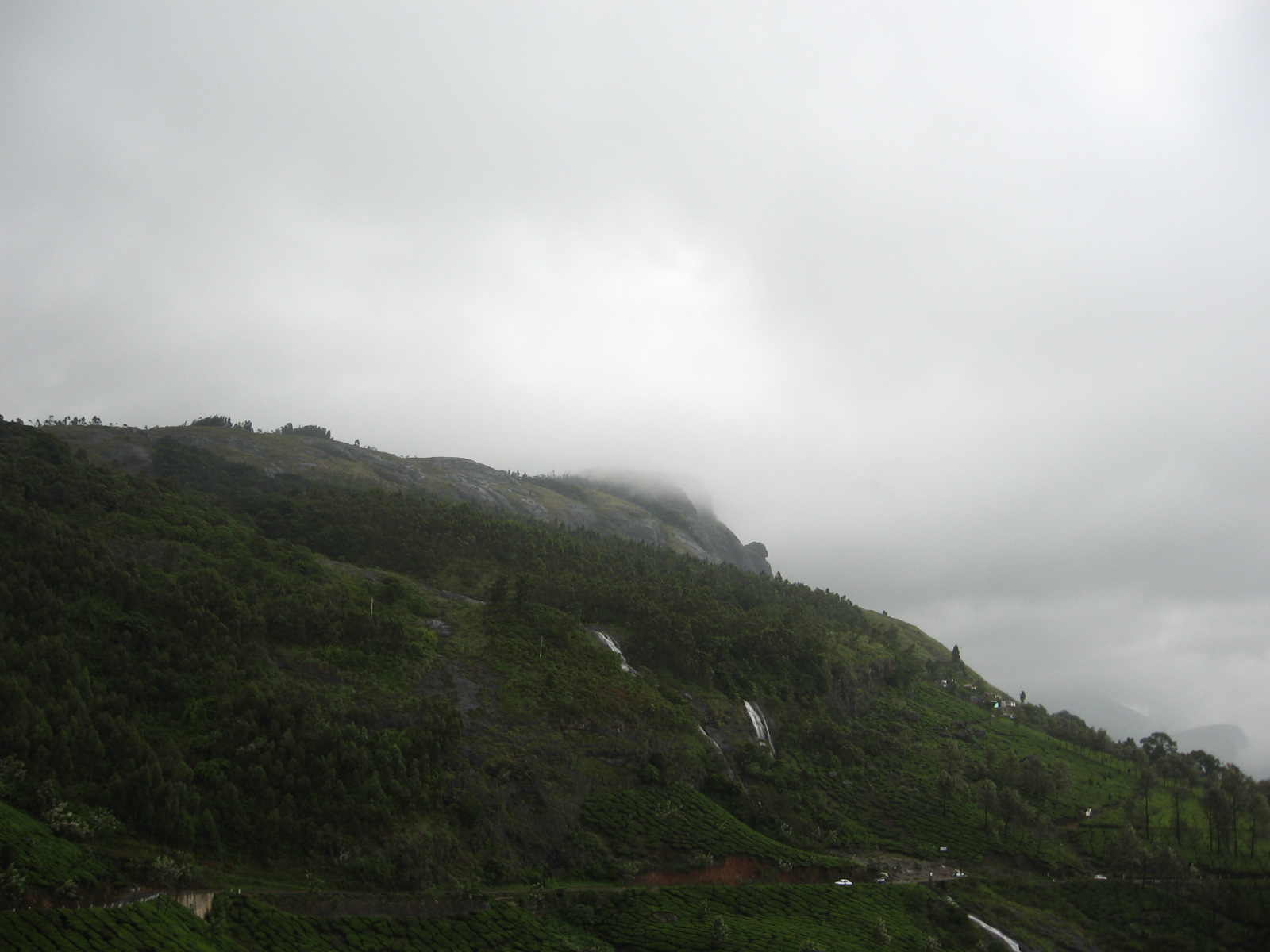
On the way to Rameswaram, you can see colourful, painted fishing boats and a sky full of circling eagles, and instead of skirting around them, buses bring you across the Western Ghats(?) between Kerala and Tamil Nadu on narrow, potholed roads that wind between hidden villages and lush green forests, through the cool mountains that are two and a half kilometres closer to heaven than the rest of South India. Still occasionally strewn with rubbish. Still too many things that made me want to melt with joy when I saw them. I can't start because I would never finish. These mountains are beautiful and amazing, and they top my list of places to go to to escape from the world forever.


Best of all, buses stop at towns, cities and bus stations along the way. Bus stations are hot, noisy, bustling and intensely alive - not to be missed.


The outcomes you face at each bus stop or station: You could miss your intended connection, in which case the literal herds of buses massing at each station offer a range of alternate routes to your destination-- but more often than not, the bus you want leaves in five minutes. Off-duty drivers and conductors are friendly and endlessly helpful. Indian bus drivers are among the most skilful in the world. India, strangely enough for being a very large and very populated country, is served by mostly single lane roads. Buses, trucks, cars and mopeds fly past each other, sending half (or all) their wheels off the road to brush past each other with a flourish of horns. After riding Indian buses for about two kilometres per rupee (two and a half cents), I will never pay to ride a roller coaster again.

Some buses sag on their left sides from worn suspension. I've seen buses in perfect condition sagging on their left sides as they ply the roads they are packed full and have ten people hanging out of each door.

The Indian bus network is a marvel of chaos and synchrony. There is very little distinction between long distance buses that ply the highways between districts and states, and the local buses that run loops between towns. They are in comfort and operation - some simply go further than others. Both stop at villages along the way, and neither adhere to any kind of strict schedule. Information is disseminated through word of mouth and observed in patterns and timings.

Somehow, Indian travelers attune themselves to this music. They must either know the buses inside out or not at all, simply slipping onto and off buses that bring them closer to their destination with each new route. I can't conceive of this system being any more efficient and effective than it already is, and buses are always full - and by Indian standards. I've had many a ride where I spent more time outside the bus than inside it.


Rameswaram, a sleepy village with a fishing problem.


On a little taxi rickshaw driving beyond Rameswaram to the tip of the peninsula closest to Sri Lanka


Amazing desert beach!

Tuesday, June 10, 2008

Tour d'Inde


If you ever plan to do an off-road bike tour in South India, don't forget to bring your poncho in case the sky falls without warning.

Saturday, June 7, 2008

The Nandri Not-Express

If you're a misadventure seeker, born with disaster in your blood, traveling unreserved (second class sitting) on India Rail is something you should definitely do. Of course, you should know exactly what you're getting yourself into. And you should, preferably, take a short trip. Note: there is a ladies only carriage in this class, which you might choose depending on your sex and whether you prefer sweaty men or screaming children. That said, India Rail is a great introduction to Indian folk and offers stunning views of the country.

The unreserved sitting class is not for sitting. There seemed to be no rules on the train, although I noticed that most of the sweaty Indian men I was squeezed in with had tickets. I tried to sneak looks at their prices to see if we had paid to travel in the same class. After frantically trying to find the "right car" to ride in, I eventually hopped onto an unreserved car, before the train departed. Because I was one of the last to get on and the carriage so full, I was squeezed in right by the door near the washrooms rather than the main cabin.

I struggled on this ride. A proud, ready, veteran of living rough, I struggled with not being able to sit or even stand properly, and struggled especially with the fact I had not slept in a day. I did this for eight or so hours on four hundred and ninety seven bone jarring kilometres of wide gauge India Rail. At least it cost me next to nothing. Funny, if I had known the carriage would be so packed and that I would not even smell a conductor, I would definitely have rode without a ticket.

I began to feel very uncomfortable as the train started moving. I felt I had made a terrible mistake. Staring contests between muzungu and natives broke out in the damp, slowly circulating air. Then, to my pleasant surprise, challenges turned to funny looks, smiles and then conversations in broken English. Indian boys offered me snacks, and helped me buy food from the vendors that swooped through the carriages when the train made its scheduled stops. They even shifted themselves and offered me floor space to sit, although it was too cramped to be comfortable. There were two people hanging out each door and one person sitting in the public wash basin.


Although you should not count on it, never underestimate local hospitality.

When I finally arrived in Madurai, it started to rain. I wanted to burst out laughing because of how dehydrated I was. I had brought and drank just two litres of water on that journey, during which the hot draught dried me out like a strip of beef jerky. A couple of (cold) iddlis from Egmore station, which I do not recommend, and a "meal" of rice casserole and fried onions on the train, which I do recommend, had plugged my digestive tract at my stomach, keeping water from absorption and making me feel bloated.

I was disappointed and relieved to arrive at Madurai. It's funny how on the train I thought I might not make it, but even after a night of fitful, restless sleep, I felt perfectly ready to take on India.

Saturday, May 31, 2008

Cold wet fish

Architects take note.

I like American airports. You probably thought you would never hear anybody say that. Yes, getting through security can be a pain when you're waiting behind everyone and their grandmothers, but once you step through that last metal detector bottle neck, you enter a communal space of open seating areas, walking spaces and overpriced and tasteless souvenir shops and news stands. What I will term the "path design" of these airports (intentional or otherwise) funnels people towards the same shared space and facilitates proximity and interaction between them.

When I stepped out of the aeroplane at my connection in Thailand I realised had been many years since I had been to Bangkok. The new airport is an atrocity and a crime against humanity. I wandered through that compartmentalised steelglassconcrete prison, strewn with the most audacious advertisements that presented gold and diamond jewellery as some kind of spiritual journey.

Disgust aside, Bangkok international airport shares many similarities with Singapore's, which has security at gate, and fences off each secure waiting area with glass walls. This allows people with dangerous items closer to the aircraft and removes any flexibility of activity between the plaza and the gate. No way of walking over to the traveler in the next gate and telling himorher how much you like hisorher We Add Up T-shirt. In Thailand, security takes the same bottleneck role, and the ticket counter separates the main path from glass-walled waiting spaces: the worst of both worlds.

On the flight into India, I realised I was there already, clear from the laughing crying chatter chatter yelling of a hundred Indian children, and their grandmothers.

---


A storm passed through today, brief and heavy, unexpected and welcome at the end of a week of scorching weather. I watched two boys moving a small herd of cows down the street, and a parent lead a crowd of particularly well behaved children in a game of free-for-all volleyball. The children here look healthy. Seemai says that they are, and that the local government has good health programs for them. I have to remember to ask him about vaccinations.

Walking back from the office, I saw a young boy, naked, squatting in the street to add his own to the carpet of waste already there and wondered about what Seemai has said. I wondered how it's possible when there is no sewage system and most waste water empties into open drains, clogged by leaves and all manner of rubbish, perhaps even too foul to breed mosquitoes. Every morning, a member from each house dredges up their drain with a narrow rake, leaving a pile of waste on the ground.

It was encouraging, I'll admit, to note that the boy didn't have diarrhoea.

Tuesday, May 27, 2008

Wide awake

I stepped out of Chennai airport one travel pack short of uneventful - one travel pack lighter than I left home with - but at least I had my Rough Guide on me, and three peanut butter sandwiches. Whatever you do, kids, make sure you keep your Rough Guide and peanut butter sandwiches in your hand-carry.

It's the perfect opposite of quiet and desolate out here in the village, but such is the pace and complexity of life that if the airline loses your bag, it's possible to survive with just one set of clothes. For a few days, I've washed the same shirt and underwear each night and slept naked, and wearing them the next day, crisp after a hot, dry night. It's wonderful and strange how quickly a human being can adapt to living in different worlds. After a few days, I'm at ease walking through the village, unconsciously dodging cow-pats and ducking through narrow alleys, grinning at shouting smiling playing children and bewildered looking adults.

From Chennai airport, it is a fifteen kilometre rickshaw-coaster ride to Egmore station, a gorgeous, deep red, Old-World magical steam-powered fairytale building on the front, and a hefty vaulted roof over the grimiest gorgeous, Old-World magical steam-powered fairytale train station in the history of rail travel in the back.


The first hint of dawn came at 4am as the station began to fill up. Despite being the only vellai karan at the station, I was ignored for the most part, although I did receive stares and one invitation from a priest to convert to Christianity. We read the first seven days of Genesis and he distilled "why God exists" into just one sentence for me: " God created everything, so how can there be no God?"

Saturday, May 24, 2008

Sheepface

In India, there are two cows for every three people.

40% of people registered as below the poverty line have paid a bribe for it.


One rough guide. Two skirts. Three pairs of underwear.

See you in India.


Okay, four pairs.