I never wrote about IDDS, did I?
In 2009, I went to Ghana for the 3rd International Development Design Summit, which is all about designing for people in developing countries, who are traditionally overlooked by companies and industries that design and manufacture products and services.
It's estimated that 90% of all design work today serves 10% of the world's wealthiest people.
IDDS combines a few key principles, such as collaborative and participatory design, where the designers work with their end users to find the best specifications to suit them, and exchange of ideas: IDDS brings together people from many fields (doctors, farmers, mechanics, students, social workers...), countries, and all ages to work on the same problems.
That year, about ten (if I remember correctly) teams came up with ten prototypes of different technologies or products that were appropriate for different people in developing countries. The problem is, we had ten prototypes and very few plans for what we would do with them next. In fact, this happened with the first and second IDDSes as well.
This year, IDDS took place in Fort Collins, Colorado, and focused on developing (business) strategies for the distribution and dissemination of technologies. About ten (ish) teams took ten already-developed or prototype technologies and worked on strategies that would turn them into effective businesses that were financially viable and spread important and useful technologies to people who needed them most.
I was extremely impressed by the final presentations (check them out if you can!) at this IDDS; It was great to see that teams were very sure of themselves and knew exactly what they were going to do over the next five years.
I also got to talk (again) to Paul Polak (founder of IDE), a brilliant and visionary old man with a wicked sense of humour and no respect for anyone at all, who was delighted to hear I would be working with his old friend Bob Nanes at IDE Ghana come January 2011.
Wowee!
Sunday, August 1, 2010


Sunday, July 25, 2010
All the best fruit
I've never spent a summer in Cambridge/Boston before, and since I like it a lot and am getting real used to living living here, I thought this summer would be a great time to live in the city. Initially I found such a "laissez faire" (someone else's words) lifestyle a little difficult. It was hard to fill my days, or feel accomplished at the end, being unemployed and unproductive.
Eventually, I settled into a groove of working remotely for Kopernik (see below), with whom I'll be working for in Indonesia this September, and dancing tango and lindy hop, the usual volunteering at Bikes Not Bombs, playing Ultimate frisbee, trying my hand at parkour, and seeing friends and meeting great people on top of and in between all that.
This turns out to be a really bad idea.
I really don't want to leave now. Perhaps I'm missing out on other great places by focusing on Boston, but it's grown so much on me. I've never had such (relatively) great social networks and lived in a place where there live so many other people I like. I enjoy my life so much here: my familiarity with the city, the great people I know, the wealth stuff there is to do. Sometimes, I feel that each day I am more desperate to enjoy my last days here, and more desperate to stay in Cambridge. Alas, this impossible.
I am, however, pretty excited about the future. It's ironic how excited I am to go, for how much I don't want to leave.
Next year, I'll work for IDE in Ghana. Before that, I'll volunteer for Kopernik in Indonesia.
Kopernik is a young non-profit that connects communities seeking technologies with organisations and companies which produce off-the-shelf technologies that are appropriate and useful, as well as ones that share blueprints and instructions to home-build technologies like wind turbines and hand-shellers for corn.
IDE is a very distinguished and experienced non-profit that develops local industries in different countries to produce and distribute useful products and services that local people need, and to do it at a profit, sustaining and growing these industries. One famous example is the drip irrigation kit. For an amount of money that can be paid back in a single harvest, a farmer can buy a kit that allows him or her to plant during the dry season or otherwise be unaffected by unpredictable or poor rainfall. This can more than double a farmer's income. That's totally crazy! What's even crazier is that the producers and sellers of the irrigation kit make a profit too.
Adventures ar icumen in.
Stay tuned!
Eventually, I settled into a groove of working remotely for Kopernik (see below), with whom I'll be working for in Indonesia this September, and dancing tango and lindy hop, the usual volunteering at Bikes Not Bombs, playing Ultimate frisbee, trying my hand at parkour, and seeing friends and meeting great people on top of and in between all that.
This turns out to be a really bad idea.
I really don't want to leave now. Perhaps I'm missing out on other great places by focusing on Boston, but it's grown so much on me. I've never had such (relatively) great social networks and lived in a place where there live so many other people I like. I enjoy my life so much here: my familiarity with the city, the great people I know, the wealth stuff there is to do. Sometimes, I feel that each day I am more desperate to enjoy my last days here, and more desperate to stay in Cambridge. Alas, this impossible.
I am, however, pretty excited about the future. It's ironic how excited I am to go, for how much I don't want to leave.
Next year, I'll work for IDE in Ghana. Before that, I'll volunteer for Kopernik in Indonesia.
Kopernik is a young non-profit that connects communities seeking technologies with organisations and companies which produce off-the-shelf technologies that are appropriate and useful, as well as ones that share blueprints and instructions to home-build technologies like wind turbines and hand-shellers for corn.
IDE is a very distinguished and experienced non-profit that develops local industries in different countries to produce and distribute useful products and services that local people need, and to do it at a profit, sustaining and growing these industries. One famous example is the drip irrigation kit. For an amount of money that can be paid back in a single harvest, a farmer can buy a kit that allows him or her to plant during the dry season or otherwise be unaffected by unpredictable or poor rainfall. This can more than double a farmer's income. That's totally crazy! What's even crazier is that the producers and sellers of the irrigation kit make a profit too.
Adventures ar icumen in.
Stay tuned!
Wednesday, July 7, 2010
Regatta de funk
You might have heard of the Couchboat.
Now, behold Couchboat Two, with two couches!

All credit to the illustrious Laura Stupin for the brilliance to put a couch on a pair of surfboards to go on the Charles river for last year's fourth of July celebration. This year, Daf and I spruced up the old surfboard chassis to take two couches and a whole bunch of extra flotation.
And by "spruced up", I meant "worked like dogs to rebuild". We designed and built a wooden space frame onto the boards that "securely" held our couches, and a system of airtight containers mounted on the underside of the boards to keep us buoyant. Couchboat Two's top speed, going downstream and with four people paddling: half a mile per hour.

Seven of us floated down the river on the mightiest and slowest of all couchboats on the Charles that day, and watched the fireworks just a couple of hundred metres from the barge they were fired from, drinking brews, eating strawberries, chips and hommus, singing sea shanties and talking the talk of pirates. Ah, simpler times.
To get home, we offloaded most of the cru at the MIT boat dock, and Daf and I unmounted the flotation from the underside of the boat as we floated in the water (itself a mighty effort) and then paddled a mile upstream to our launch site.
With lots of help, we carried the boat and couches home, we managed to finish at 3 or 4 am. We were completely exhausted and worn out, but extremely pleased with the success of our mission.
Next year, look out for the grand premiere of Loungeboat.
Now, behold Couchboat Two, with two couches!

All credit to the illustrious Laura Stupin for the brilliance to put a couch on a pair of surfboards to go on the Charles river for last year's fourth of July celebration. This year, Daf and I spruced up the old surfboard chassis to take two couches and a whole bunch of extra flotation.
And by "spruced up", I meant "worked like dogs to rebuild". We designed and built a wooden space frame onto the boards that "securely" held our couches, and a system of airtight containers mounted on the underside of the boards to keep us buoyant. Couchboat Two's top speed, going downstream and with four people paddling: half a mile per hour.

Seven of us floated down the river on the mightiest and slowest of all couchboats on the Charles that day, and watched the fireworks just a couple of hundred metres from the barge they were fired from, drinking brews, eating strawberries, chips and hommus, singing sea shanties and talking the talk of pirates. Ah, simpler times.
To get home, we offloaded most of the cru at the MIT boat dock, and Daf and I unmounted the flotation from the underside of the boat as we floated in the water (itself a mighty effort) and then paddled a mile upstream to our launch site.
With lots of help, we carried the boat and couches home, we managed to finish at 3 or 4 am. We were completely exhausted and worn out, but extremely pleased with the success of our mission.
Next year, look out for the grand premiere of Loungeboat.
Wednesday, May 26, 2010
Good jelly
(if you like bikes, building stuff, or design for developing countries, click all the links!)
On this sunny day did five intrepid explorers ride from olde Cambridgeport to Carlisle to visit the honourable Gwyndaf Jones.
Not only is Gwyn one of my favourite people ever, he's also Welsh. Over lunch he recounted a story from a past visit to Wales. Apparently, there are so few Welsh names and so fewer surnames, that when our hero found himself standing in a cemetery, he had to look but two stones away to find the grave of one Gwyndaf Jones.
---
Spang, Daf (another Welshman who makes my list of favourite people ever), Amelia (who rode across the USA last year!), Laura and I put some food, brews and ice into some panniers and rode up the lush green Minuteman trail and then into the woods to find Gwyn at his gorgeous little house.
Gwyn has an amazing story. He worked as a BMW motorcycle mechanic once, and started one of the first super-high-end titanium racing bicycle companies, Merlin Metalworks, just one town over in Somerville MA. Today, he's a mentor for D-lab design classes, and teaches his own cycle-focused class at D-lab. He collaborates with Guatemalan bicycle-machine inventors and builders, and Indian rickshaw businesses, to name a few.

Gwyn's house is beautiful and cosy, and his workshops and store rooms packed with the most exquisite hand tools and bicycle history: old bikes, one-off crazy experimental bike frames, and beautiful (and huge) hand saws, planes, and files. We brave mosquitoes the size of bees on a little jaunt into the woods by his house, where a tree hangs with a hundred rejected Merlin frames, the steel completely rusted but the titanium pristine and shiny.
Alas, all good things do end and Gwyn took us on a lovely ride on a track through the woods on our way back to Cambridge. I'm already planning my next ride out to Carlisle.

On this sunny day did five intrepid explorers ride from olde Cambridgeport to Carlisle to visit the honourable Gwyndaf Jones.
Not only is Gwyn one of my favourite people ever, he's also Welsh. Over lunch he recounted a story from a past visit to Wales. Apparently, there are so few Welsh names and so fewer surnames, that when our hero found himself standing in a cemetery, he had to look but two stones away to find the grave of one Gwyndaf Jones.
---
Spang, Daf (another Welshman who makes my list of favourite people ever), Amelia (who rode across the USA last year!), Laura and I put some food, brews and ice into some panniers and rode up the lush green Minuteman trail and then into the woods to find Gwyn at his gorgeous little house.
Gwyn has an amazing story. He worked as a BMW motorcycle mechanic once, and started one of the first super-high-end titanium racing bicycle companies, Merlin Metalworks, just one town over in Somerville MA. Today, he's a mentor for D-lab design classes, and teaches his own cycle-focused class at D-lab. He collaborates with Guatemalan bicycle-machine inventors and builders, and Indian rickshaw businesses, to name a few.

Gwyn's house is beautiful and cosy, and his workshops and store rooms packed with the most exquisite hand tools and bicycle history: old bikes, one-off crazy experimental bike frames, and beautiful (and huge) hand saws, planes, and files. We brave mosquitoes the size of bees on a little jaunt into the woods by his house, where a tree hangs with a hundred rejected Merlin frames, the steel completely rusted but the titanium pristine and shiny.
Alas, all good things do end and Gwyn took us on a lovely ride on a track through the woods on our way back to Cambridge. I'm already planning my next ride out to Carlisle.

Monday, February 15, 2010
Mastershoes
Almost exactly a month after leaving Cambridge for Arusha, I find myself back in Cambridge again. It's funny how different life is in different parts of the world. In some places, people walk, in others the cycle or ride or drive. In Arusha, people smile and call out to you and jest about your haircut, and in Boston and Singapore, you move too fast or are too far away from people to have almost any interaction at all.
Today, I sit here on my bed and feel like I have all the things I'll ever need in my life around me, tucked away in the attic of a Cambridgeport house and built into a quiet little Cambridge life I'm really getting used to. But! Is it so? Let's examine this issue.
Today, I sit here on my bed and feel like I have all the things I'll ever need in my life around me, tucked away in the attic of a Cambridgeport house and built into a quiet little Cambridge life I'm really getting used to. But! Is it so? Let's examine this issue.
A good friend of mine Chris told me as we cut across Jamaica Plain on our bikes about some thinking that was solidifying in his head. This theory isn't universal, but rings eerily close to my experience.
So, imagine you had my parents, and think for a moment about what it's like to be home. Life has a sort of fundamental certainty to it. Your parents (might) have lived in the place for a long time, decades perhaps. Their social network is huge. With a roguish sort of economist grin, I'd pin a name on this that sounds something like "personable capital".
Life is easy when you're home and you can hop on this network, and use this capital built up over years. There is no uncertainty about who to look for if you need something, and there is great certainty that if you need something, you can find it. You have the same family doctor and dentist you've had for years, maybe generations, and a dozen different cousins and aunts and uncles, and then friends, who are accountants, travel agents, stock brokers and everything in between.
Chris describes it as being "failure proof", how options abound. Even if you were completely out of luck striking into the world on your own, you could always find something to fall back onto. The network is powerful. Indeed, we build networks of our own everyday, and Chris is absolutely sure (and I quite convinced) that the world doesn't work through the "normal channels" but rather through the tapping -nay, milking- of networks.
But networks today are different, just as people are. One might think, I haven't stayed in the same place for two years- sure, my parents have, but I haven't had time (and perhaps physical constraints in space and travel) to build the same things they had. Now moving is cheap, and people move around a lot. We keep in touch with cell phones and emails and spread networks across the world. Chances are, if I drop into some city tomorrow, I might find someone I know nearby in the same province or state. We still hang on to people, just in different ways. Eh?
Thursday, February 4, 2010
safi sana
Back in Cambridge, it's all reverse culture shock again.
In Arusha, hot on the heels of 2010 (which we celebrated with a second goat)-
I think this will be a ramble...
Let me take a couple of seconds to recount history. We celebrated Christmas with a goat. Now, I very much believe in living lightly on the world, and as such I choose to consume next-to-no animals and animal derived products (I also cycle everywhere, althought I must say this is as much out of convenience as concern, and showering is another story entirely-) although I am not opposed to the consumption of animals on any kind of moral grounds. I would be super excited keep chickens for their eggs (it's a beautiful, if an essentially weird relationship if you ask me). They would eat worms and crap and kitchen scraps, and eating them would affirm the ancient adage that we are what we eat: at the end of the day, poop.
And the great Tom Waits did say, "most of the things you absorb you will ultimately secrete."
In Arusha, hot on the heels of 2010 (which we celebrated with a second goat)-
I think this will be a ramble...
Let me take a couple of seconds to recount history. We celebrated Christmas with a goat. Now, I very much believe in living lightly on the world, and as such I choose to consume next-to-no animals and animal derived products (I also cycle everywhere, althought I must say this is as much out of convenience as concern, and showering is another story entirely-) although I am not opposed to the consumption of animals on any kind of moral grounds. I would be super excited keep chickens for their eggs (it's a beautiful, if an essentially weird relationship if you ask me). They would eat worms and crap and kitchen scraps, and eating them would affirm the ancient adage that we are what we eat: at the end of the day, poop.
And the great Tom Waits did say, "most of the things you absorb you will ultimately secrete."
I would hunt animals for food, if I had to. If I was in the jungle and had to eat an animal to survive, I would, easy. So whilst I did not eat this goat, I did watch its slaughter and subsequent parting out into various cuts and edible bits with great interest. After all, in America, goats come in parts from the supermarket. This was a real goat, it had to die and be parted.
It was the most visceral experience of my life thus far, I must admit I felt a little strange watching blood run and hearing air hiss from lungs. I don't think death had ever been this close, apparent, or bloody to me before. Watching the goat be cut up was easier. It reminded me of a time in Boston before I attended a sustainability fair and watched an artisan butcher skilfully cut up a (happy?) organic free range hog.
This brings us now to the second goat (this one seemed to come conveniently already in parts -- the skin was nowhere in sight), roasted in a grill made out of an oil drum at Shaibu's swanky bachelor pad, where we celebrated the new year. Shaibu is a dude. He manages the bike programs at Tumaini, the workshop at Global Alliance for Africa's Vijana (youth) centre. Many people have overheard conversations about the centre (mostly in America) and thought we were talking about something else altogether.


"Damn! The meat won't fit on the stove! Good thing we have this nifty oil barrel grill!"
Our stay in Arusha was punctuated by visits to the nearby village of Nadosoito to demonstrate and gather views and feedback about GCS products. The first ended up being mostly a long, scenic walk through the village, which is absolutely beautiful: mountains on the horizon, and filled with beautiful people working hard in fields. The second was accompanied by business and management guru Javier, who taught us so so many lessons about how to characterise a market (besides talking to people and finding out how much land they had and how their harvests were- which we did), how to find demands for a product and willingnesses to pay, and also neat tricks on finding information about customers. The trick is, quite unintuitively, to try lots and lots of different ways to sell your product to different people. And we sold one, and sat in the shade of a mud brick house drinking tea and talking to John the farmer about his harvests, his family. Bernard's father did mechanical work for John, and John knew Bernard since he was but a child. Small world.

----
We passed our following days building up documentation and fiddling with corn shellers (did you know the majority of maize eating people worldwide shell their maze by hand?), learning to build dynamo-cellphone chargers by hand on our daily trips to Mwamba's house.
We had two last adventures before we departed this magnificent city. The first of these was the Mama Afrika circus, with acrobats who jumped and twisted through the air, climbed poles upside down and swung from trapeze and silk (which was announced by the circusmaster as "aerial tissue"). There were young boys who could bend their bodies in half the wrong way, and squeeze through squash rackets. There were also three young men who:
-juggled clubs
-juggled little straw hats (their routine was amazing)
-rapped
-breakdanced
I was also unwittingly recruited by a clown to be part of his four piece rock band. I was lead vocal.
The second adventure was a leisurehike with the D-lab Tanzania team through the lush green foothills of Mount Meru to a waterfall. Rain mid-hike made the going treacherous and slow, and I began to get frustrated with what began as an fresh, exciting hike on a beautiful day. We walked our way down a winding stream in a jungle river valley, hopping over slippery rocks, and ducking under outcroppings of rock worn down by years of water. Finally, we arrived in a huge clearing I can't seem to find a good object to compare in size to. It was completely overgrown with lush green vines and gigantic ferns, a wispy stream of water rushing from some high place to crash down two hundred feet below. It felt like I was in the land of the dinosaurs.
Alas, great things must come to an end, and a few days later, I passed through Nairobi, got on a plane and went "home" to Singapore for a few days. It had been a long time, my parents had moved into a new house, and Singapore was as weird as ever. Nevertheless, it was a pleasant week spent at home.
It was the most visceral experience of my life thus far, I must admit I felt a little strange watching blood run and hearing air hiss from lungs. I don't think death had ever been this close, apparent, or bloody to me before. Watching the goat be cut up was easier. It reminded me of a time in Boston before I attended a sustainability fair and watched an artisan butcher skilfully cut up a (happy?) organic free range hog.
This brings us now to the second goat (this one seemed to come conveniently already in parts -- the skin was nowhere in sight), roasted in a grill made out of an oil drum at Shaibu's swanky bachelor pad, where we celebrated the new year. Shaibu is a dude. He manages the bike programs at Tumaini, the workshop at Global Alliance for Africa's Vijana (youth) centre. Many people have overheard conversations about the centre (mostly in America) and thought we were talking about something else altogether.

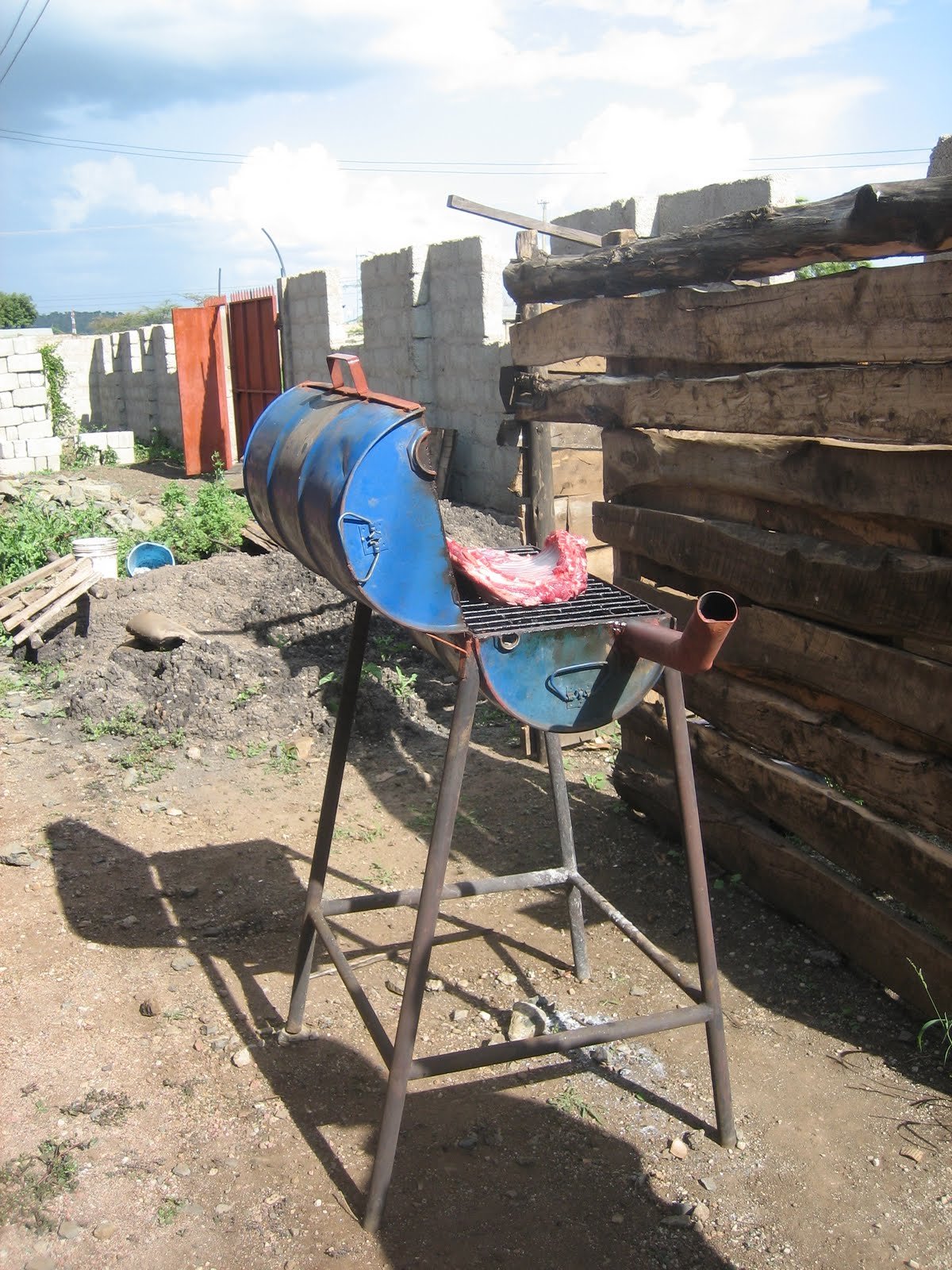
"Damn! The meat won't fit on the stove! Good thing we have this nifty oil barrel grill!"
Our stay in Arusha was punctuated by visits to the nearby village of Nadosoito to demonstrate and gather views and feedback about GCS products. The first ended up being mostly a long, scenic walk through the village, which is absolutely beautiful: mountains on the horizon, and filled with beautiful people working hard in fields. The second was accompanied by business and management guru Javier, who taught us so so many lessons about how to characterise a market (besides talking to people and finding out how much land they had and how their harvests were- which we did), how to find demands for a product and willingnesses to pay, and also neat tricks on finding information about customers. The trick is, quite unintuitively, to try lots and lots of different ways to sell your product to different people. And we sold one, and sat in the shade of a mud brick house drinking tea and talking to John the farmer about his harvests, his family. Bernard's father did mechanical work for John, and John knew Bernard since he was but a child. Small world.

----
We passed our following days building up documentation and fiddling with corn shellers (did you know the majority of maize eating people worldwide shell their maze by hand?), learning to build dynamo-cellphone chargers by hand on our daily trips to Mwamba's house.
We had two last adventures before we departed this magnificent city. The first of these was the Mama Afrika circus, with acrobats who jumped and twisted through the air, climbed poles upside down and swung from trapeze and silk (which was announced by the circusmaster as "aerial tissue"). There were young boys who could bend their bodies in half the wrong way, and squeeze through squash rackets. There were also three young men who:
-juggled clubs
-juggled little straw hats (their routine was amazing)
-rapped
-breakdanced
I was also unwittingly recruited by a clown to be part of his four piece rock band. I was lead vocal.
The second adventure was a leisurehike with the D-lab Tanzania team through the lush green foothills of Mount Meru to a waterfall. Rain mid-hike made the going treacherous and slow, and I began to get frustrated with what began as an fresh, exciting hike on a beautiful day. We walked our way down a winding stream in a jungle river valley, hopping over slippery rocks, and ducking under outcroppings of rock worn down by years of water. Finally, we arrived in a huge clearing I can't seem to find a good object to compare in size to. It was completely overgrown with lush green vines and gigantic ferns, a wispy stream of water rushing from some high place to crash down two hundred feet below. It felt like I was in the land of the dinosaurs.
Alas, great things must come to an end, and a few days later, I passed through Nairobi, got on a plane and went "home" to Singapore for a few days. It had been a long time, my parents had moved into a new house, and Singapore was as weird as ever. Nevertheless, it was a pleasant week spent at home.
Life goal: only own so much stuff that I can carry on my back. It's slow progress, but I've stopped checking bags on airplanes, and learning my goal one month at a time.


Monday, January 4, 2010
mchizi kama ndizi
Arusha is a neat place: a friendly little town sitting in the lush green shadow of Mt Meru, Tanzania's second tallest mountain.
I arrived in Arusha, Tanzania to cheers of "Bruce Lee! Bruce Lee!"
Alright, so it didn't quite happen that way. Bernard picked us up in his lovely sky blue beetle and whisked us off to begin three weeks of mystery and adventure, volunteering at GCS in Arusha.

Global Cycle Solutions is the brainchild of Jodie Wu and Lisa Tacoronte, MIT alum and student, both D-lab veterans and entrepreneurs. We soon settled into a comfortable routine of hopping onto dalla-dalla's (vans) each morning and riding out to Bernard's dad's house to document the tech development of a top secret! GCS product, doing some work in the afternoon on an instruction manual and cooking rice and beans for dinner.
The first night, we met Jodie's next-door neighbours - Mic and Mas, two members of Contagious (or was it Contagiouz?), a band of young men who:
- breakdance
- rollerskate
- don't drink
- don't smoke
On the second night, we watched them perform a show and throw down some serious moves at a local bar/club.
We seem to be surrounded by Arusha's most exceptional people. Bernard's father moved to Arusha from Moshi when he was young, starting small with just a simple provision store. Over the years, he began to buy cars from junk yards, fix them up and then sell them, earning enough money to buy tools, sewing machines, a flour mill, land.
Today, he's a local celebrity. Dalla-dalla's in Sinoni will know where you want to stop if you say "Mwamba's house". Bus drivers recognise Bernard by face as Mwamba's son. They live in a spacious three storey house with a yard always full of vehicles in line for repair work and the largest accumulation of Volkswagen spare parts in the country...maybe on the continent! Bernard and his brother Peter are both accomplished mechanics from growing up working on cars with dad.

Bernard bought his lovely sky-blue beetle from a scrap yard where it was rusting away, for about four hundred dollars. He spent three months to fix every single part in it by hand, and then got it painted sky-blue. It's beautiful.
Their house is a really happy place; Bernard's sister Stella sewing clothes, his brother Peter fixing cars or radios, both of whom are always happy to talk to you if you walk by. They have a yard full of chickens and tons of Bernard's neat inventions, like homemade solar water heaters and a pedal-powered drill press(!!!) Bernard's two nieces are the sweetest children I've ever seen. Melinda sneaked up on me one day whilst I was eating lunch and poked me in the small of my back with a tiny finger. I jumped two feet into the air from my seat.
Oops, took a video instead of a picture
I arrived in Arusha, Tanzania to cheers of "Bruce Lee! Bruce Lee!"
Alright, so it didn't quite happen that way. Bernard picked us up in his lovely sky blue beetle and whisked us off to begin three weeks of mystery and adventure, volunteering at GCS in Arusha.

Global Cycle Solutions is the brainchild of Jodie Wu and Lisa Tacoronte, MIT alum and student, both D-lab veterans and entrepreneurs. We soon settled into a comfortable routine of hopping onto dalla-dalla's (vans) each morning and riding out to Bernard's dad's house to document the tech development of a top secret! GCS product, doing some work in the afternoon on an instruction manual and cooking rice and beans for dinner.
The first night, we met Jodie's next-door neighbours - Mic and Mas, two members of Contagious (or was it Contagiouz?), a band of young men who:
- breakdance
- rollerskate
- don't drink
- don't smoke
On the second night, we watched them perform a show and throw down some serious moves at a local bar/club.
We seem to be surrounded by Arusha's most exceptional people. Bernard's father moved to Arusha from Moshi when he was young, starting small with just a simple provision store. Over the years, he began to buy cars from junk yards, fix them up and then sell them, earning enough money to buy tools, sewing machines, a flour mill, land.
Today, he's a local celebrity. Dalla-dalla's in Sinoni will know where you want to stop if you say "Mwamba's house". Bus drivers recognise Bernard by face as Mwamba's son. They live in a spacious three storey house with a yard always full of vehicles in line for repair work and the largest accumulation of Volkswagen spare parts in the country...maybe on the continent! Bernard and his brother Peter are both accomplished mechanics from growing up working on cars with dad.

Bernard bought his lovely sky-blue beetle from a scrap yard where it was rusting away, for about four hundred dollars. He spent three months to fix every single part in it by hand, and then got it painted sky-blue. It's beautiful.
Their house is a really happy place; Bernard's sister Stella sewing clothes, his brother Peter fixing cars or radios, both of whom are always happy to talk to you if you walk by. They have a yard full of chickens and tons of Bernard's neat inventions, like homemade solar water heaters and a pedal-powered drill press(!!!) Bernard's two nieces are the sweetest children I've ever seen. Melinda sneaked up on me one day whilst I was eating lunch and poked me in the small of my back with a tiny finger. I jumped two feet into the air from my seat.
Oops, took a video instead of a picture
Subscribe to:
Posts (Atom)

 Posts
Posts

